Objective 2: Learn how to professionally communicate with victims of a felony crime over the phone.
Activities/Resources
· Research effective communication techniques
· Observe my supervisor during victim conferences and telephone conversations.
· Discuss with my supervisor which techniques work best and why
· Communicate with a victim over the phone with my supervisors guidance
Evidence
· Include research of effective communication techniques
· Include notes in regards to observations and discussions with my supervisor
· Include mock transcripts of me communicating with a victim
.JPG.opt447x335o0,0s447x335.JPG)
Above, I am talking to a victim on the phone. As an impromptu call, I grabbed the first note pad I could find to take notes as I actively listened.
The following links below present the observations I made during victim conferences, the research I conducted in regards to effective communication techniques, and supervisor approved mock transcripts of conversations I had with victims over the phone. The observations section distills the important techniques I observed my supervisor using on a daily basis and on a per victim basis while the outside research fills in any of the holes I was missing from my internship experience. The mock transcripts were based on conversations I had while gaining victim impact. The purpose of these conversations were to find out what victims wanted to happen in a case, which were to then be used by the judge and lawyers while trying to agree on a plea agreement during pre-trial conferences. I included two types of conversations: a straightforward conversation and a complicated one. The first is straightforward because the victims knows exactly what they want to happen and it is realistic, whereas the second is the exact opposite. These calls are more challenging because it is daunting to get victims who have no idea what they want to happen in a case to open up. Also, it could be overwhelming trying to answer questions victims asks while trying to gain impact at the same time. Lastly, the idea of telling victims that their wishes are not going to come exactly true is always a tricky situation.
Talking with these victims allowed me to expand upon a lesson I learned during my introductory communications class, which is that talking to others is only half of the conversation. For if a true conversation is to happen, like the ones I had with my victims, both parties have to constantly be participating in the discussion by talking and listening. As the different explanations in regards to the transcript showed all the victims want something different. What I learned while fielding these various types of calls is that I must always remain attentive and calm, for this is the best way to hear what the victims truly wants so I could resolve any of their issues or concerns. Therefore, the different transcripts showcase my ability to effectively react towards different victims needs in a confident professional manner. The professional aspect came from observing my supervisor and doing my own outside research. For keeping this information in mind taught me what was proper conduct around victims in the legal field. Therefore, the notes I took distill many of the main points needed to be a victims advocate and the fact I can recognize these points highlight my understanding of what is considered to be the best professional conduct.
In order to arrive at these lessons I started observing my supervisor. Each night after my internship I wrote down what happened during the day. I would then reflect on how my supervisor responded to each of the victims. Over time I went through my notes looking for patterns that she used either knowingly or unknowingly. Then I directly asked my supervisor what techniques she used with every victim to make sure I overlooked nothing. Other notes I took were in regards to discussions I had with my supervisor after the conferences. She has a psychology major so she would often inform me as to why certain victims act the way they did. Knowing the psychological behavior behind people’s actions would also influence how my supervisor approached the situation. Since I am not a victim’s advocate or a psychology major I went online to find information about communication equivalent to a text book that a professor would give their students. The few on-line lessons on communicating with victims were mainly .org sites and for the psychological sites I made sure they were mainly .edu endings. I then used all of this information to guide me during my phone calls with victims. When I originally started these telephone conversations I was not always able to get the victims to open up to me about the case in order to gain the victim impact the judge wanted due to nerves. To overcome this problem I would read a prompt so I could effectively start and end the conversations. Since I was weak at this task I made an effort to do more of the calls in order to learn from my mistakes and feel more comfortable doing these discussions. Slowly I became decent enough to call without my prompt, but I still felt like the victims were missing something from me. Luckily, my supervisor consistently gave me advice to improve my skills and I found that one day her words of wisdom on top of all the research I was doing finally clicked. Now I am to the point where I have to actively think about a way to politely get off the phone with the victims.
The form I use to take notes during telephone conversations with victims. To protect confidential information the information on the form has been made up. | 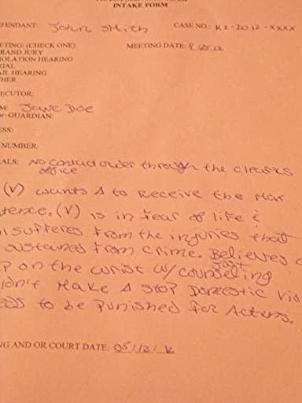 |

